



Denny Taegeukgi Keyring (2026 Asian Games)
常规价格
$21.00
Product Size: Keyring : 80x55mm(±5mm)
Package Size : 85x170x30mm
Product Weight: approx. 40g
Product Material: (Outer fabric & filling) Polyester 100%
Relic
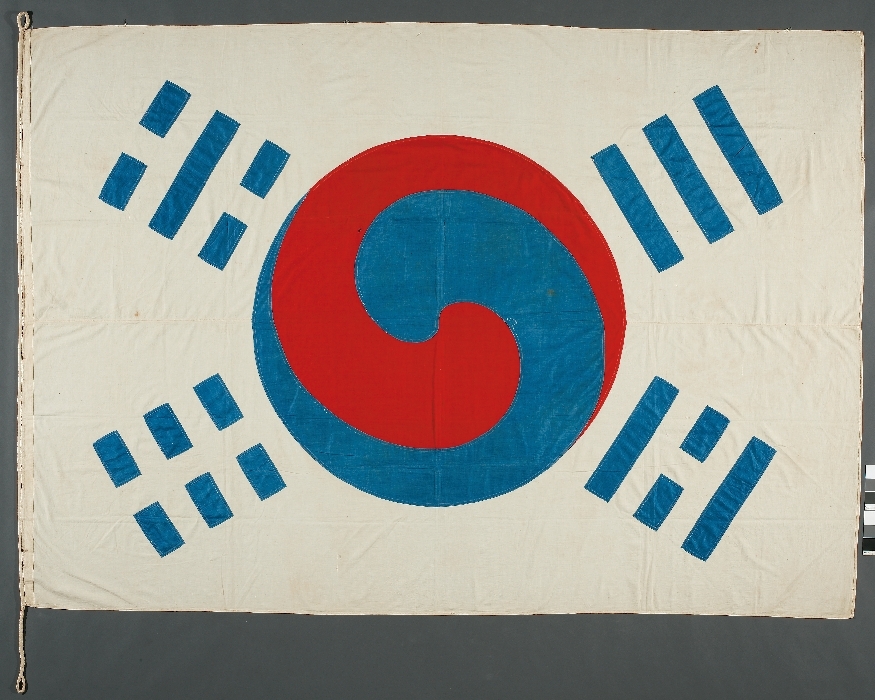
This Taegeukgi was taken to the United States by Owen N. Denny (1838–1900), an American who served as a diplomatic adviser to Emperor Gojong (r. 1863–1907) from 1886 to 1890. After being dismissed at the behest of Qing China, he returned to the United States in May 1890, and the flag later became known as the “Denny Taegeukgi.” It is considered the oldest surviving Taegeukgi preserved in Korea today.
During his tenure as diplomatic adviser, Denny argued in his book China and Korea that, under the principles of modern international law, Korea was a sovereign and independent nation. He strongly criticized Qing China's interference in Korean affairs and refuted the claim that Korea was a subordinate state of China.
After Denny died without heirs in 1900, the flag was preserved by his family for generations. It was eventually donated to Korea on June 23, 1981, by William C. Ralston, who had received it from the family.
A cord believed to date from the time the flag was made remains attached to its right side, indicating that the flag was originally hung from a flagpole on that side. This may be related to the traditional practice of writing from right to left. Comparison of the taegeuk emblem on this flag with those found on other Taegeukgi made during the same period suggests that it may have been sewn on in reverse.
The flag was designated Registered Cultural Heritage No. 382 in 2008 and was re-designated as Treasure No. 2140 in 2021.![]()